

B2B Shop | Compressed Air | Filtration | Technology

FILCOM On-Site Service: Installation, Maintenance, Repair & Rental Fleet

Regional, flexible and close to you

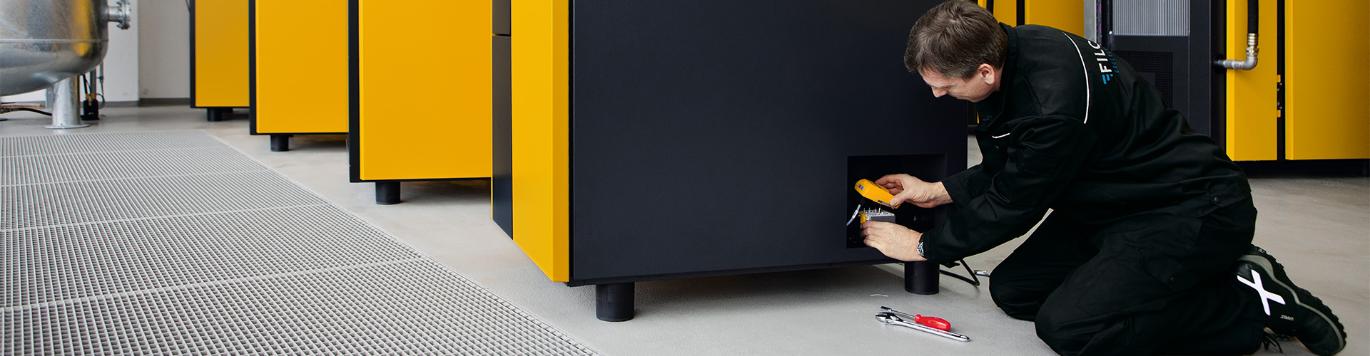
As an authorized KAESER service partner, we carry out installation, maintenance and repair work on your compressed air stations and related components. We service systems from all major manufacturers – in accordance with manufacturer specifications and VDMA guideline 15392.

FILCOM provides fast, expert support 24/7 via our emergency hotline. For short-term additional demand or total failure, we provide rental compressors and auxiliary equipment.


Certificates


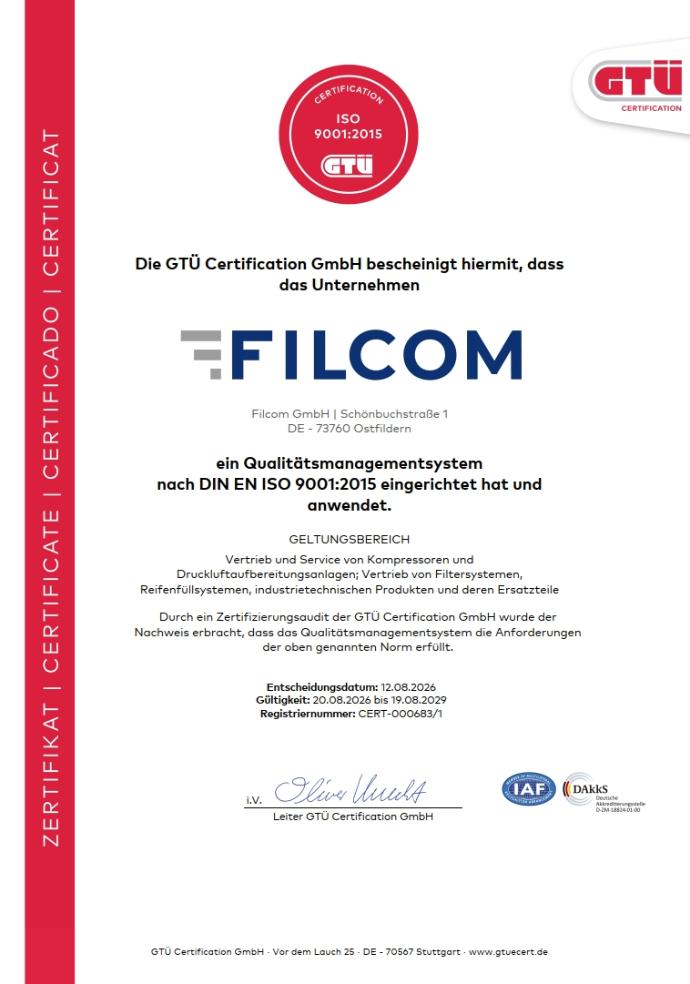
Certificate according to ISO 9001:2015                  


Our compressed air services at a glance


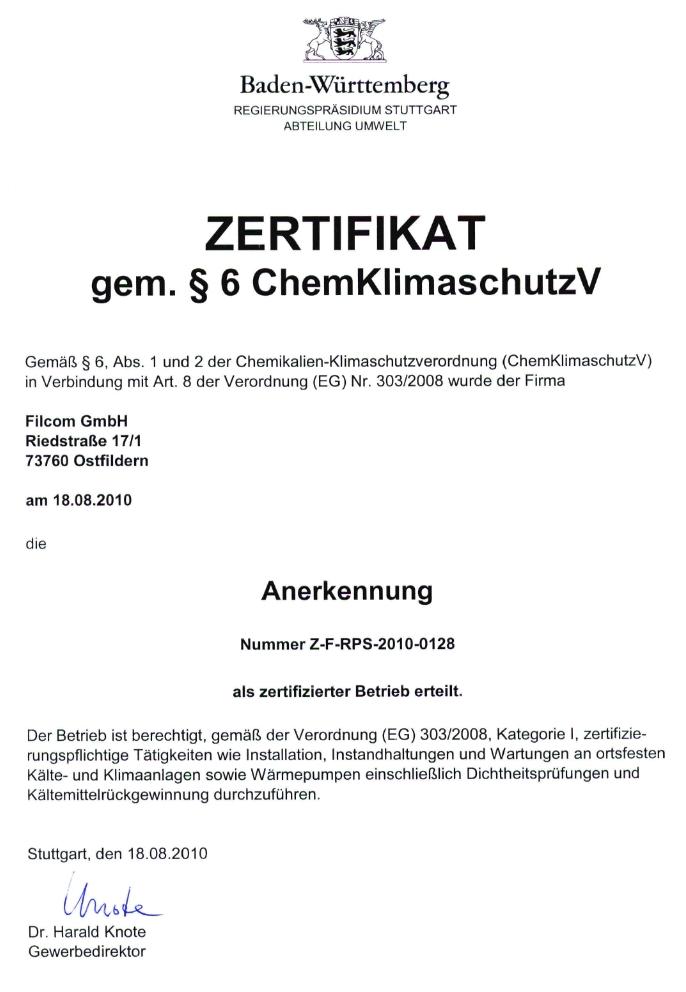
Trained refrigeration technician, categories 1 and 2 according to Section 5 ChemKlimaSchutzV          

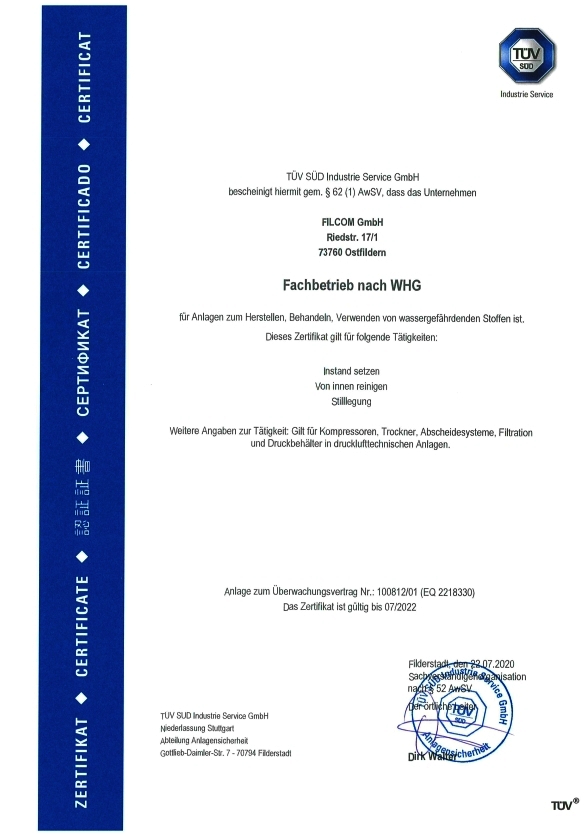
WHG 2028

Certified specialist company according to Section 62(1) AwSV (formerly under WHG) 
                      

Maintenance & preparation for vessel inspections

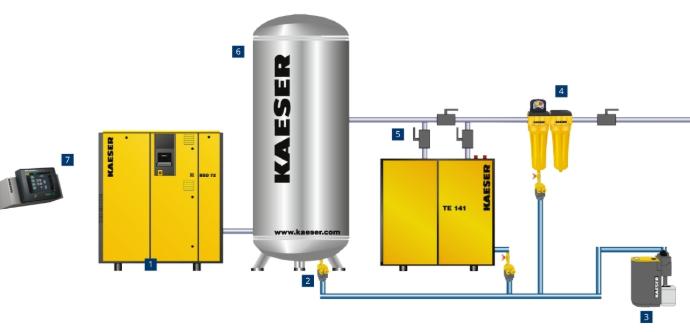
  1. Compressor maintenance: All maintenance-relevant components such as filters and valves are replaced according to manufacturer specifications. Regular maintenance minimizes downtime, reduces energy costs and increases operational safety.
  2. Condensate drain maintenance: Annual function checks and replacement of wear parts prevent malfunctions and moisture in the compressed air network.
  3. Oil-water separator maintenance: Condensate must be treated in accordance with Section 7a of the German Water Resources Act (WHG). We handle filter changes, cleaning and function checks for your safety and the environment.
  4. Filtration maintenance: Annual element replacement ensures consistent compressed air quality and prevents energy losses caused by increased differential pressure.
  5. Refrigeration dryer maintenance: Cleaning the condenser and checking the refrigerant circuit in accordance with EU regulations ensures your refrigeration dryer operates properly.
  6. Preparation for recurring inspections: We support you in preparing internal inspections (max. 5 years) and strength tests (max. 10 years) of compressed air receivers by approved inspection bodies.
  7. Controller maintenance: Updates to the latest software version.

Installation & piping

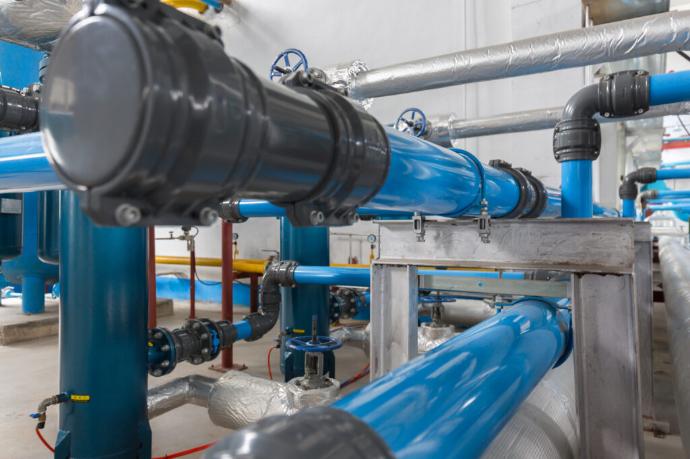
FILCOM handles the professional installation of compressed air stations and piping networks. With our partners AIRpipe and Transair, we use modern, modular aluminum piping systems that are quick to install, easy to expand and reliable in operation.

These systems feature low leakage rates, high tightness, corrosion-free materials and minimal pressure losses. Their lightweight design and installation with few tools save time and costs and enable energy-efficient compressed air distribution.

FILCOM stands for precise workmanship, high quality and long-lasting solutions.

Consumption and leakage measurement

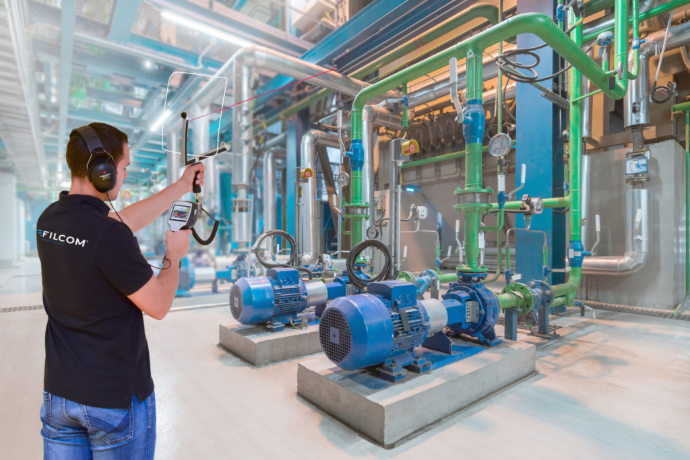
Transparency for your compressed air costs. In many systems, 25–40% of the compressed air generated is lost through leaks. Using modern measurement technology, FILCOM makes your actual consumption visible and identifies savings potential.

For this, we use precise ultrasonic leak detectors, data loggers and sensors from CS-Instruments, Airleader and KAESER measurement technology to record all relevant compressed air parameters. This allows leaks to be located, documented and economically assessed during operation. At the same time, we record consumption, load profiles and quality indicators such as dew point, residual oil and particles.

The result: clear data, less energy loss and a solid basis for operating your compressed air system more efficiently and cost-effectively.

Service for the following brands

Compressors: KAESER, AGRE, Almig, Alup, Boge, Compair, MAHLE, Mark, Renner, Schneider

Air treatment: KAESER, Beko, Parker/Zander, Dominik-Hunter, Donaldson, FST, MTA, Wortman

Measurement: CS-Instruments, KAESER


Useful knowledge about compressed air systems

Based on many years of hands-on experience from our experts

Compressed air – a hidden energy guzzler

In many areas, compressed air is a silent energy guzzler – and leaks often drive up costs unnoticed. 

Large leaks can often be recognized by a hissing sound. Or does your compressed air system show a continuous pressure drop?

And leaks are not the only way you lose money: every unnecessary bar of pressure increases your energy costs by 10%. 

Curious how much savings potential your company has?

Contact us


FAQ – Why should compressed air systems be serviced regularly?

Why should systems be serviced regularly?

Regular maintenance ensures efficiency, operational safety and a long service life for your systems. It avoids unnecessary costs from energy losses, downtime or new purchases and protects the compressor from harmful operating conditions such as heat, dust or continuous load.

Original parts or third-party parts

Third-party parts may seem to save costs but can cause damage. This leads to higher repair costs and can jeopardize warranty claims.
We always use original parts wherever possible. For older models where original parts are no longer available, we offer equivalent parts that have proven themselves over many years.

Carrying out maintenance

Always keep a close eye on your compressor's maintenance intervals and order the required services in good time. Procuring the necessary replacement parts can sometimes take a few days, so planning ahead – also with regard to service technician availability – is important. 

Maintenance by specialized service technicians

FILCOM GmbH's regularly trained service technicians do more than just replace maintenance parts on compressors: they keep an eye on the entire compressed air station, including air treatment, ventilation, heat recovery, electric control valves and the software versions of the controllers. 

Benefits of a maintenance contract 

A maintenance contract defines the scope of services for your compressed air station. 
Intervals follow manufacturer specifications – annually or based on operating hours. Monitoring of your equipment subject to TÜV inspection.
Stocking of all maintenance parts for the respective equipment. 

Typical weak points in compressed air systems

Damaged seals on pneumatic control valves
Outdated compressed air consumers, e.g. oversized pneumatic tools
Leaking connection hoses and quick couplings
Outdated condensate separators
Rusty pipes
Deposits in the pipes
Dirty filters
Overdue service visits