

Autumn is Tire-Changing Season
October marks the start of the switch to winter tires in automotive workshops. Most drivers are familiar with the "O to O" rule of thumb—October to Easter—and many book their appointments during the same few-week window. Added to this is the requirement to use winter tires based on driving conditions: in Germany, only tires bearing the Alpine symbol are permitted when roads are slippery or covered in slush or ice.
For your workshop, this means that vehicle lifts, impact wrenches, and tire inflators operate continuously over a short period. Every minute lost per vehicle reduces the total number of appointments completed by the end of the day.
The Bottleneck Often Only Noticed During the Season
In autumn, throughput is often determined not by the number of vehicle lifts, but by the compressed air supply. If impact wrenches are being used at two or three bays simultaneously, the system pressure drops if the compressor is undersized. The consequences are immediately apparent at the workstation:
- Wheel nuts are harder to loosen; the impact wrench requires more attempts.
- Tire inflation takes longer because the compressor struggles to keep up with demand.
- The compressor operates with a very high duty cycle, leading to increased temperatures and wear.
You can check whether your system is affected: How much does the pressure drop when all bays are operating simultaneously, and how long does the compressor take to refill the tank?
What a workshop compressor needs to deliver for tire service
In tire service, four factors matter: sufficient air output, stable pressure, versatility, and suitability for continuous operation.
Requirement | Why it matters in autumn |
|---|---|
Air output | Multiple impact wrenches and tire inflators operate simultaneously; the air delivery rate must cover peak demand. |
Stable pressure | Tools only operate at full power when line pressure remains constant. You can also precisely adjust tire pressure using a digital tire inflator gauge. |
Versatility | The same system also powers vehicle lifts, grinders, and spray guns—eliminating the need for a second compressor. |
Suitability for continous operation | The system must handle numerous load cycles daily over a period of weeks without overheating. |
If you also perform painting work, you should consider compressed air quality: condensate and oil in the lines can cause paint defects. You can find suitable components in our online shop!
Compressed air treatment in the FILCOM shop
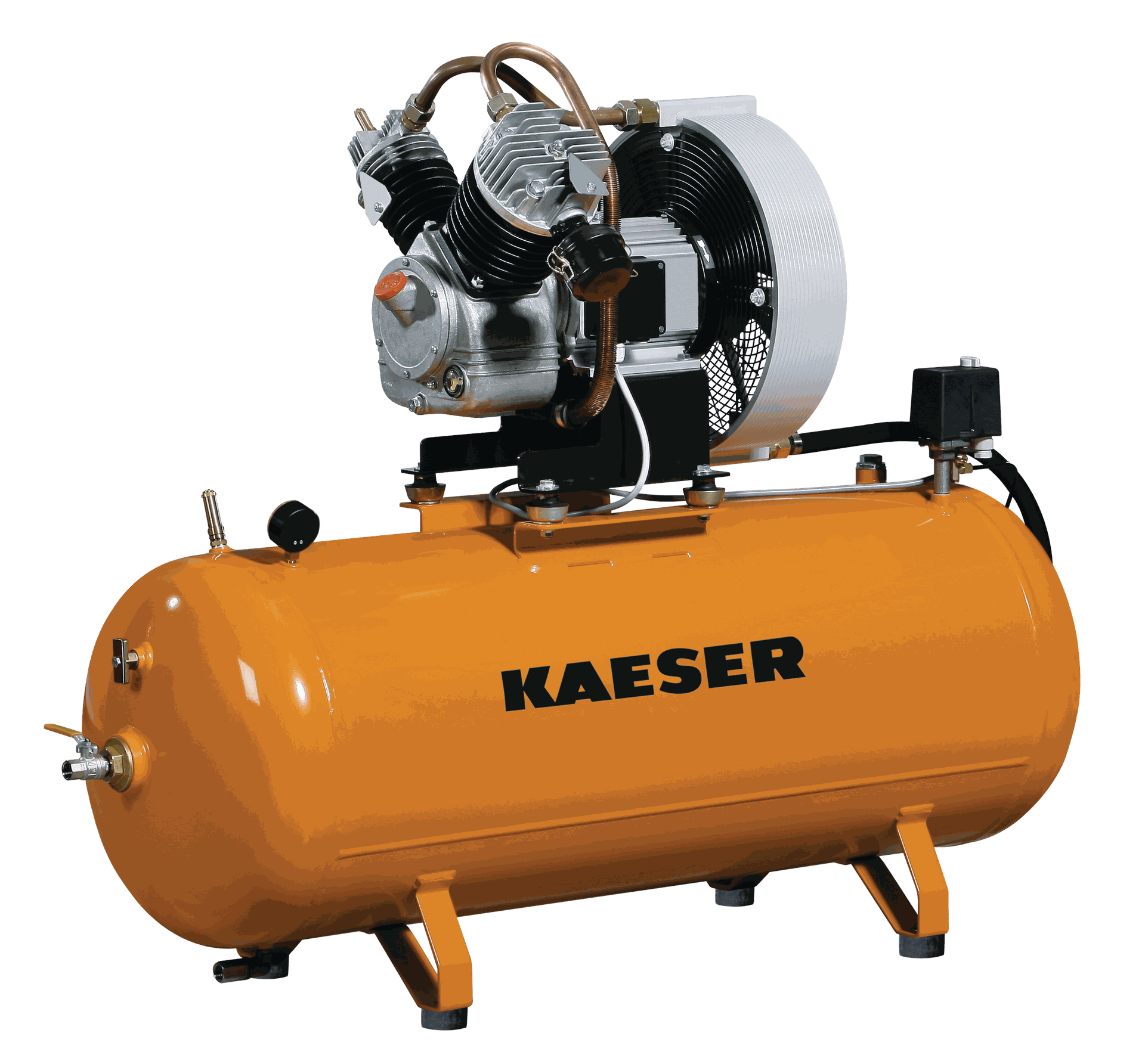
KAESER EUROCOMP: The piston compressor for automotive workshops
KAESER EUROCOMP (EPC) series stationary piston compressors are designed for the demands of daily workshop operations and are used in numerous automotive and tire service centers. You can choose between horizontal, vertical, or separately installed air receivers—ensuring the system fits even in confined spaces.
Features | Benefits for the workshop |
|---|---|
German-made compressor block (KAESER) | Long service life with a high duty cycle |
Direct coupling between motor and compressor block | No belts; reduced transmission losses and operating costs |
Aluminum ring-profile aftercooler | Low compressed air temperature; profile also acts as a protective guard |
Dual vibration isolation | Quiet operation; reduced vibration transmitted to the floor and lines |
Sound-insulating enclosure (optional) | Reduces sound pressure levels by up to 10 dB(A) |
Horizontal, vertical, or separate air receiver | Flexible installation based on available space |
You can find the EUROCOMP series here in our online shop.
View the EUROCOMP series in the shop
15 bar: Reserve capacity for "boosting"
The two-stage EUROCOMP models achieve a maximum pressure of 15 bar. This pays off during tire mounting: a short, powerful burst of air securely seats the tire bead in the rim well before the tire is inflated to the target pressure.
This "boosting" function saves time and rework, particularly with wide tires, low-profile tires, and tires taken from cold storage. The higher system pressure serves as a reserve; you set the actual tire inflation pressure as usual using the tire inflator gauge.
CHECKLIST: Getting your compressed air system ready for autumn
- Measure the pressure drop when all workstations are drawing air simultaneously
- Check the compressor maintenance interval; schedule oil and filter changes before the start of the season
- Drain condensate from the tank and lines, or check the condensate drains
- Inspect hoses, couplings, and fittings for leaks
- Check the tire inflator for proper function and gauge accuracy
- Verify that the available air delivery capacity matches the number of workstations
Compressed air consultation for your workshop
As an authorized KAESER dealer in Baden-Württemberg, FILCOM designs your compressed air supply based on actual consumption—considering the number of workstations, the tools used, and the available installation space. We are happy to provide on-site consultation at your workshop and assess compressed air requirements directly at the workstations. Upon request, our service team can also handle pre-season maintenance.
Contact the FILCOM GmbH team right now and schedule an appointment at your site!


Wilfried Leitenberger
COMPRESSED AIR TECHNICAL CONULTATION